Children Cancer Stories by Rukh Yusuf - Blog # 262

I am Rukh Yusuf, Clinical Pharmacist, also specialized in Total Parenteral Nutrition and Bone Marrow Transplant. I have worked in the Pediatric Oncology unit of a public hospital. The mission of this blog is to bring to you the real-life stories of child patients suffering from cancer. Cancer is still a difficult disease to handle and treat. However, when it strikes the children, some so young that they cannot even speak, their agony is beyond expression and words. Let us pray especially for children suffering from cancer for early and complete remission. May Allah shower His Merciful Blessings upon them. Aameen.
Arham is five years old. Until a few months ago, his days followed a familiar rhythm, school in the morning, cartoons in the afternoon, and small negotiations with his mother over finishing his meals. He liked cars, especially the ones that could be taken apart and reassembled. His father often joked that Arham asked more questions in a day than he could answer in a week.
The changes began quietly. It was not something that could be pointed to on a single day. His mother first noticed that he was getting tired more easily. After coming home from school, instead of running around the house, he would lie down on the sofa, sometimes without even changing out of his uniform. There were evenings when he fell asleep before dinner, something that had never happened before.
At first, it was easy to attribute it to routine childhood fatigue. School had become slightly more demanding, and the weather in Lahore had been fluctuating. But then came the fevers low-grade, persistent, often returning at night. They were not alarming enough to rush to the hospital, but they lingered long enough to cause unease.
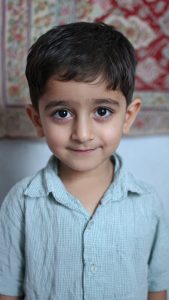 His parents are both educated, attentive, and accustomed to making informed decisions. His father works in a corporate setting, and his mother, though currently at home, has a background in education. They are not unfamiliar with medical information, nor are they quick to panic. Still, there was a point when reassurance began to feel insufficient.
Arham started developing small bruises on his legs. At first, they seemed like the usual marks of childhood perhaps from playing or bumping into furniture. But there were more of them, and some appeared in places that didn’t quite make sense. His mother also noticed that he had become unusually pale. There was a softness to his face that had replaced the usual flush of a healthy child.
The decision to seek further evaluation came not out of fear, but out of a quiet understanding that something was not right.
The diagnosis; “pediatric leukemia” arrived after a series of tests, consultations, and waiting. For Arham, the hospital visits were confusing more than frightening. He asked questions about the machines, about why blood was being drawn so often, and whether he could go back to school soon. His world had not yet adjusted to the gravity of what was happening.
For his parents, the moment was different. It did not unfold dramatically. There were no visible breakdowns or immediate expressions of despair. Instead, there was a kind of stillness, a pause where information had to be processed carefully, piece by piece. They listened, asked questions, took notes, and thanked the doctors.
They could afford treatment. That fact, while significant, did not soften the emotional weight of the diagnosis. It simply removed one layer of uncertainty. The rest remained.
Their home has changed in subtle ways. There is now a corner dedicated to medications, neatly arranged and labeled. Appointments are written on a calendar that is checked multiple times a day. Conversations between the parents often happen in lower tones, not because they are hiding something, but because they are trying to maintain a sense of normalcy for Arham.
His mother spends more time observing him how much he eats, how long he sleeps, whether he seems more tired than usual. These observations are not obsessive, but they are constant. His father, who once returned home and immediately engaged in play, now takes a moment before entering the house, as if preparing himself to step into a space that requires a different kind of presence.
Arham’s symptoms continue to shape their days. There are mornings when he wakes up with less energy, when even getting dressed feels like a task. There are days when he complains of vague aches in his legs, pointing to areas that cannot always be clearly defined. His appetite varies, some days he eats normally, on others, even his favorite foods are left untouched.
Despite this, there are moments that remain unchanged. He still asks for stories at night. He still wants to know why certain things work the way they do. He still laughs at small jokes, though sometimes the laughter is shorter, followed by a quiet pause.
The family does not speak about the illness in overwhelming terms. They have chosen a language that is measured and age appropriate. Arham knows that he is unwell and that the doctors are helping him get better. He does not yet carry the full understanding of the diagnosis, and his parents are careful not to impose it prematurely.
Their extended family has been supportive, but the immediate experience remains deeply personal. It is in the small decisions like what to tell Arham, how to structure the day, when to express concern and when to hold it back, that the real challenge lies.
There is no dramatic shift in their identity as a family. They are still who they were, but with an added layer of responsibility that requires patience, resilience, and a kind of quiet endurance. The routines they once took for granted now require adjustment, and the future, though still present, is approached with more caution.
Arham remains at the center of it all, not as a symbol of struggle, but as a child navigating a phase he does not fully understand. His parents walk alongside him, not always with certainty, but with a steady commitment to being present, attentive, and composed.
The story is not defined by extremes. It is shaped by the in-between moments the waiting, the observing, the adapting. It is in these moments that the weight of the diagnosis is most clearly felt, not through overt expressions, but through the quiet, continuous effort to hold everything together.
Prayers for these brave souls and their families who have to face this pain of cancer. May Allah make it easy for them. Aameen


No comments:
Post a Comment